
Training Settings for Anesthesiology Residents
Disclaimer: This article is intended solely for informational and educational purposes only. It does not constitute medical advice.
Training for anesthesiologists begins in medical school and continues through residency and beyond. Though all anesthesiology residents must be proficient in core skills and knowledge, training settings are diverse and provide exposure to different cases and patients, ultimately resulting in different clinical experiences. These differences can be valuable for the development of physicians’ unique styles and clinical senses. On the other hand, since clinical practice prizes reproducibility and generalizability, different training settings can complicate continuity and consistency. This is a particular concern in anesthesiology, which prioritizes safety and may involve complex cases.
High-fidelity training scenarios are widely used across training settings to teach and reinforce fundamental skills to anesthesiology residents. Training programs employ actors and high-fidelity mannequins to recreate clinical scenarios. There are several advantages to this strategy, with one of the most important being the controlled nature of the environment. Since the entire scenario is simulated and reproducible, it allows trainees to develop the muscle memory and skills necessary to manage real-life clinical scenarios without the stress and stakes that such scenarios necessarily entail. Furthermore, these training scenarios are customizable.
This allows trainers to simulate scenarios that may be rarely encountered in real clinical practice but are nevertheless essential to be aware of should they occur. For example, cases of malignant hyperthermia—a potentially fatal patient reaction to some anesthetics—are rarely encountered in real life, but it is nevertheless essential that anesthesiologists are prepared to manage the scenario should it ever arise. Indeed, realistic simulation serves as an invaluable, risk-free educational platform that drastically improves patient safety and clinical preparedness during these rare events (Green et al., 2016).
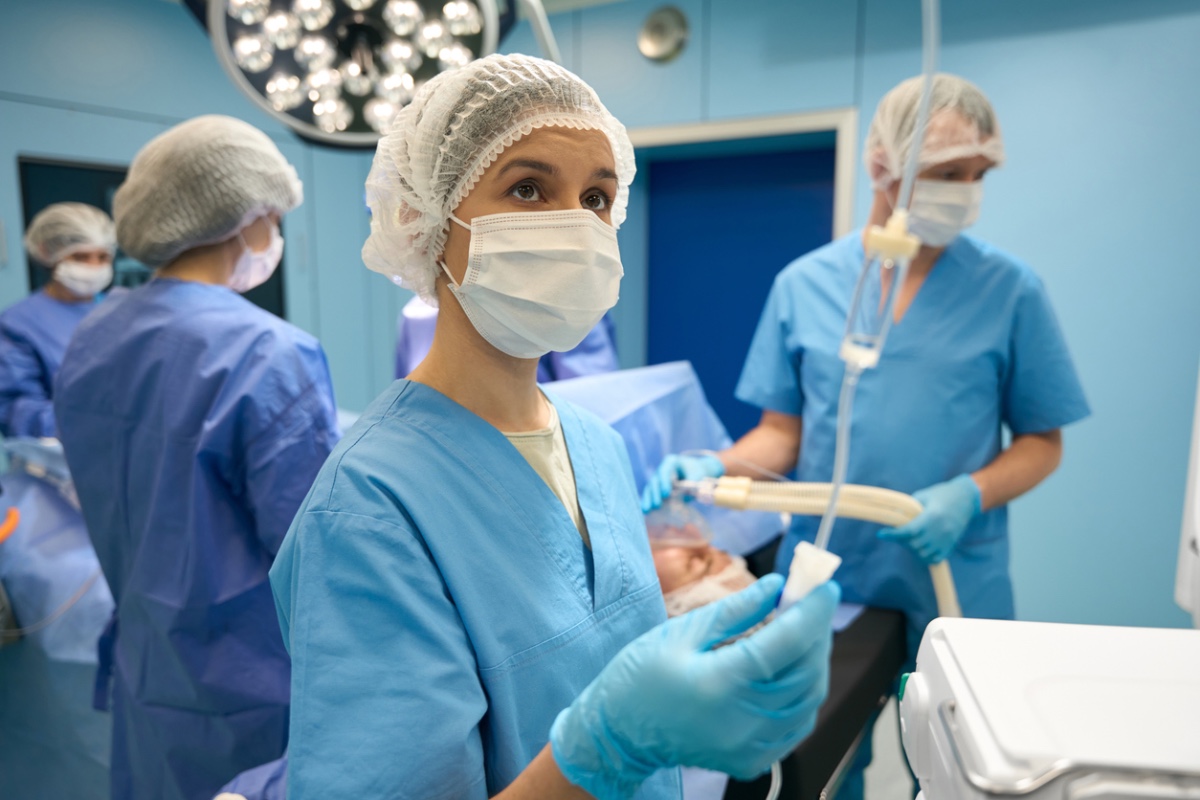
Despite the benefits of controlled, simulated environments, traditional clinical training in real clinical environments with real patients remains the most important circumstance for learning. Unlike a training center, the operating room is staffed with real team members who bring unique perspectives and dispositions with them as they perform their roles within the surgical field. Incorporating realistic clinical encounters into training helps bridge the gap between isolated medical knowledge and holistic, patient-centered communication in these busy settings. Additionally, learning to navigate interpersonal complexities is an essential skill for an anesthesiologist to develop (Hon et al., 2026). Residency programs aim to expose trainees to a wide variety of cases in order to best prepare them for practice; however, this exposure is naturally informed by the case load, patient demographics, systems, and culture of the particular center.
Beyond standard elective surgery, residents must also be prepared for high-acuity, unpredictable settings like trauma centers. Because trauma exposure in standard residency can be highly variable, educators advocate for standardized, case-based curricula in these areas to ensure that residents develop critical cognitive, psychomotor, and nontechnical leadership skills that cannot be guaranteed through elective cases alone (Blaine et al., 2023).
Ultimately, preparing competent anesthesiologists requires a careful balance between simulation and spontaneity. While the unpredictability of the operating room and trauma bay teaches residents to manage real-world human dynamics and cognitive fatigue, simulation standardizes their exposure to rare, life-threatening emergencies. By combining these diverse training settings, modern anesthesiology training programs aim to shape residents with variable experiences into clinicians with a standardized foundation of safe, reproducible, and highly skilled patient care.
References
- Blaine, K. P., Dudaryk, R., Milne, A. D., Moon, T. S., Nagy, D., Sappenfield, J. W., & Teng, J. J. (2023). Training anesthesiology residents to care for the traumatically injured in the United States. Anesthesia & Analgesia, 136(5), 861–876. https://doi.org/10.1213/ane.0000000000006417
- Green, M., Tariq, R., & Green, P. (2016). Improving patient safety through simulation training in anesthesiology: Where are we? Anesthesiology Research and Practice, 2016, 1-12. https://doi.org/10.1155/2016/4237523
- Hon, K. J., et al. (2026). Addressing social determinants of health in anaesthesiology: a series of simulation cases for resident trainees. BMJ Open Quality, 15(3), e004094. https://doi.org/10.1136/bmjoq-2025-004094