
Physiological Impacts of Chronic Infections and Perioperative Considerations
Disclaimer: This article is intended solely for informational and educational purposes only. It does not constitute medical advice.
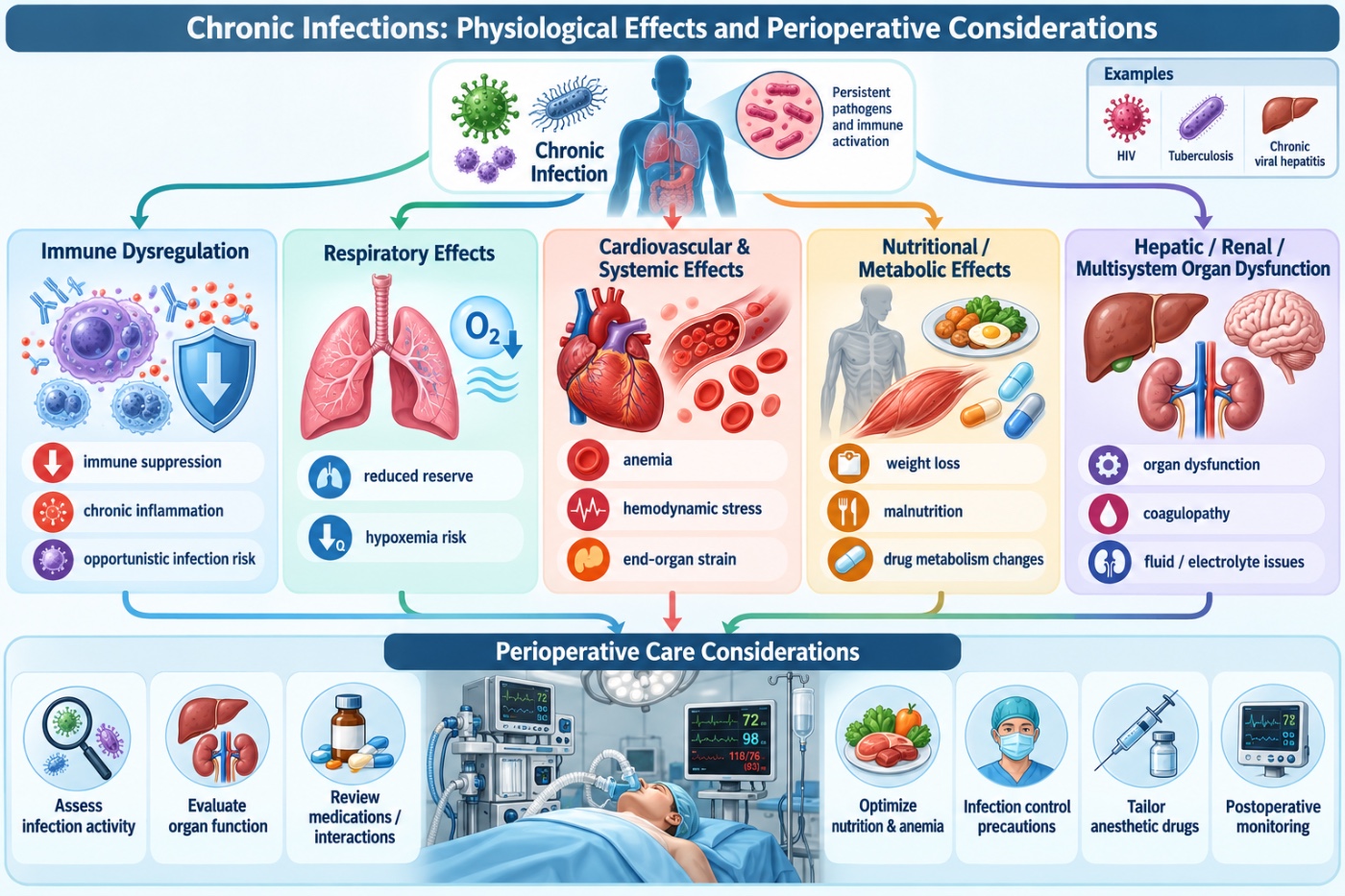
Chronic infections present unique challenges for perioperative management due to the physiological impacts of sustained or repeated infection. Unlike acute infections, which typically produce a rapid inflammatory response, chronic infections can sustain immune activation over months or years, progressively damaging tissues and reducing organ reserve. Different types of infection, such as HIV, chronic viral hepatitis, tuberculosis, and persistent device-associated infections, also affect perioperative risk through different mechanisms. The central challenge is distinguishing the effects of ongoing infection from established organ dysfunction, as each requires a different management approach.
Surgery triggers an inflammatory surge followed by transient immune suppression. Delayed recovery of innate immune function has been associated with postoperative infections.1 In patients with chronic infections, preexisting immune dysfunction may compound this response. Persistent inflammation can also contribute to endothelial injury, anemia, malnutrition, and impaired wound healing. Nutritional deficiencies further compromise collagen synthesis and tissue repair, increasing vulnerability to postoperative complications.2
Chronic hepatitis progressing to cirrhosis illustrates how these effects can extend across organ systems. Portal hypertension and altered hemostasis increase the complexity of bleeding and thrombotic risk, while systemic vasodilation and cirrhotic cardiomyopathy may limit tolerance of anesthetic induction and fluid shifts. Impaired hepatic metabolism further complicates medication selection.3
Preoperative evaluation in patients experiencing chronic infections should establish whether infection remains active and identify any significant organ damage to guide perioperative decision-making. Uncontrolled infection may justify postponing elective surgery to allow treatment, whereas established dysfunction requires individualized risk assessment and anesthetic adjustments. In tuberculosis, priorities include determining infectiousness, evaluating pulmonary reserve, and identifying treatment-related hepatotoxicity or neuropathy.4
In HIV, viral load, CD4 count, and antiretroviral adherence guide assessment. Patients with viral suppression and preserved immune function can generally proceed with surgery without additional HIV-related restrictions. Those with uncontrolled viremia or advanced immunosuppression may require further optimization.5 For patients with cirrhosis, conventional MELD and Child-Pugh scores do not fully capture procedure-specific risk. The VOCAL-Penn score incorporates surgical characteristics and comorbidities to provide more individualized mortality estimates.3
Intraoperative management requires particular attention to antimicrobial drug interactions with anesthetics. Ritonavir- or cobicistat-boosted antiretroviral regimens inhibit CYP3A4, potentially prolonging the effects of fentanyl and midazolam. Remifentanil, metabolized by plasma esterases, is an alternative for analgesia and anesthesia, and cisatracurium may be the preferred option for neuromuscular blockade to avoid drug interactions.
When aminosteroid neuromuscular blockers are used, quantitative monitoring helps identify prolonged blockade. Conversely, rifampin induces hepatic enzymes, potentially reducing exposure to sedatives and analgesics.4 Drug selection must therefore reflect the patient’s specific antimicrobial regimen and organ function.
Anesthetic technique may also influence perioperative immune responses. Volatile anesthetics and propofol exhibit different immunomodulatory effects, although whether these differences meaningfully alter postoperative infection rates remains uncertain.6 Established preventive measures, including normothermia, appropriate glucose management, and timely surgical antimicrobial prophylaxis, remain essential.
Postoperatively, patients with significant immune dysfunction or reduced organ reserve require surveillance for infection, wound complications, and organ decompensation. Maintaining essential antimicrobial therapy, supporting nutrition, and encouraging early mobilization can facilitate recovery. Coordination among anesthesiologists, surgeons, infectious disease specialists, and other relevant clinicians is particularly important in complex cases. Ultimately, chronic infection is not itself a contraindication to surgery. Perioperative safety for patients with chronic infections depends on identifying active disease, quantifying residual organ dysfunction, anticipating drug interactions, and tailoring management to the patient’s physiological reserve.
References
- Jacobs LMC, Bijkerk V, Albers-Warlé KI, Reijnders-Boerboom GTJA, Drager LD, Helder LS, Sumpter NA, van Eijk LT, Pickkers P, Visser J, Keijzer C, Joosten LAB, Warlé MC. Perioperative immune dynamics and infectious complications: a pooled-data analysis of prospective studies. Int J Surg. 2026 Feb 20. doi: 10.1097/JS9.0000000000004977. Epub ahead of print. PMID: 41718478.
- Seidelman JL, Mantyh CR, Anderson DJ. Surgical Site Infection Prevention: A Review. JAMA. 2023 Jan 17;329(3):244-252. doi: 10.1001/jama.2022.24075. PMID: 36648463.
- Mahmud N, Fricker ZP, McElroy LM, Qayed E, Wong RJ, Ioannou GN. ACG Clinical Guideline: Perioperative Risk Assessment and Management in Patients With Cirrhosis. Am J Gastroenterol. 2025 Sep 3;120(9):1968-1984. doi: 10.14309/ajg.0000000000003616. PMID: 40899690.
- Rai E, Alaraimi R, Al Aamri I. Pediatric lower respiratory tract infection: Considerations for the anesthesiologist. Paediatr Anaesth. 2022 Feb;32(2):181-190. doi: 10.1111/pan.14382. Epub 2021 Dec 27. PMID: 34927318.
- Coccolini F, Improta M, Sartelli M, Rasa K, Sawyer R, Coimbra R, Chiarugi M, Litvin A, Hardcastle T, Forfori F, Vincent JL, Hecker A, Ten Broek R, Bonavina L, Chirica M, Boggi U, Pikoulis E, Di Saverio S, Montravers P, Augustin G, Tartaglia D, Cicuttin E, Cremonini C, Viaggi B, De Simone B, Malbrain M, Shelat VG, Fugazzola P, Ansaloni L, Isik A, Rubio I, Kamal I, Corradi F, Tarasconi A, Gitto S, Podda M, Pikoulis A, Leppaniemi A, Ceresoli M, Romeo O, Moore EE, Demetrashvili Z, Biffl WL, Wani I, Tolonen M, Duane T, Dhingra S, DeAngelis N, Tan E, Abu-Zidan F, Ordonez C, Cui Y, Labricciosa F, Perrone G, Di Marzo F, Peitzman A, Sakakushev B, Sugrue M, Boermeester M, Nunez RM, Gomes CA, Bala M, Kluger Y, Catena F. Acute abdomen in the immunocompromised patient: WSES, SIS-E, WSIS, AAST, and GAIS guidelines. World J Emerg Surg. 2021 Aug 9;16(1):40. doi: 10.1186/s13017-021-00380-1. PMID: 34372902; PMCID: PMC8352154.
- Ye J, Deng M, Liao Y, Li J, Jia X, Li C, Wu K. The immunomodulatory landscape of anesthetic agents: Mechanisms, clinical implications, and therapeutic potential. Eur J Pharmacol. 2026 Oct 7;1037:179401. doi: 10.1016/j.ejphar.2026.179401. Epub ahead of print. PMID: 42843699.