
Use and Effects of Jet Ventilation During Surgery
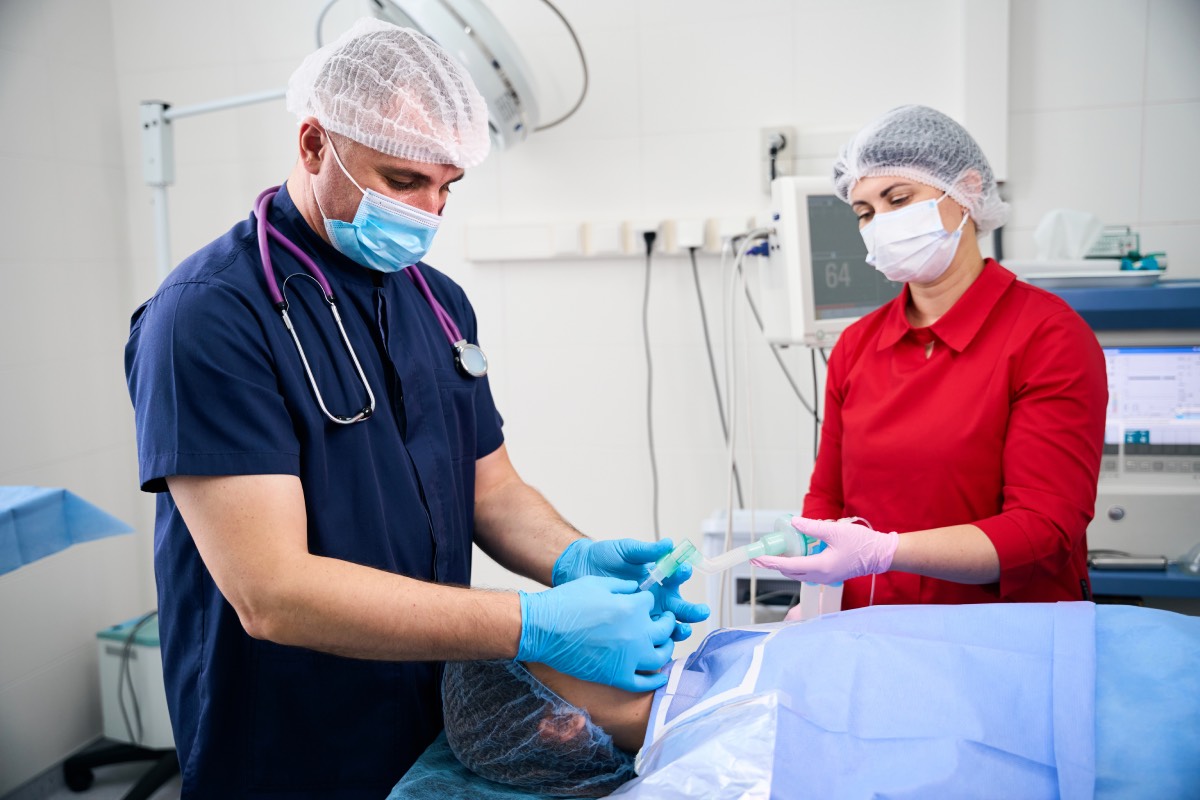
Supraglottic jet oxygenation and ventilation has emerged in the field of otolaryngology as a means of providing ventilation while performing complex, intricate procedures within the airway. It has also been explored as an alternative to endotracheal intubation in patients who cannot spontaneously breathe but are not candidates for traditional artificial ventilation strategies. The ability of this technique to provide a “tubeless” airway and unobstructed surgical field produces significant benefits. However, there are also risks and considerations that must be accounted for in any setting where jet ventilation is employed.
The primary difference between traditional endotracheal intubation and jet ventilation is that the latter does not require advancement of the aeration device past the vocal cords. During typical endotracheal intubation, a tube is placed through the vocal cords into the trachea to provide positive-pressure ventilation. The tube acts as a conduit that allows externally pressurized air to access the patient’s lungs and facilitate ventilation.
Jet ventilation, however, avoids instrumentation through the larynx by providing oxygenation through high-pressure bursts of air that utilize the Venturi effect, in which high-velocity gas entrains surrounding air, and Taylor dispersion, which enhances gas mixing and diffusion within the airways. Unlike the bulk flow of gases in traditional mechanical ventilation, jet ventilation utilizes a high-velocity gas stream that creates a pressure gradient, effectively entraining ambient air along with the pressurized burst. This allows for adequate oxygenation even with a narrow-gauge cannula, utilizing high-frequency pulses of about 60 to 150 per minute to facilitate gas exchange through molecular diffusion (Wei, 2025).
These characteristics make jet ventilation particularly advantageous during airway surgery. The absence of a tube in the surgical field enables more direct surgical access and lowers the risk of compromising the airway during the operation. Furthermore, there has been documented success in using the technique as an alternative to tracheostomy in patients experiencing “cannot intubate, cannot oxygenate” emergencies, which constitute a significant source of patient mortality in anesthetic practice (Li et al., 2016). Recent meta-analyses have further confirmed that jet ventilation significantly reduces the incidence of hypoxemia during bronchoscopy compared to standard oxygen therapy, providing a more stable physiological profile for high-risk patients (Huang et al., 2026).
However, jet ventilation presents certain risks. In patients with a compromised airway due to tracheal damage, jet ventilation is contraindicated because of the risk of barotrauma from the highly pressurized airflow. It is also associated with risks of lung hyperinflation, which can damage delicate alveolar structures and paradoxically impair ventilation. A significant clinical hurdle is the difficulty of intraoperative monitoring; because jet ventilation is an open system, end-tidal carbon dioxide readings are often unreliable, forcing clinicians to rely on frequent arterial blood gas sampling or transcutaneous monitoring (Wei, 2025). Additionally, the high-pressure pulses generate a “functional PEEP” that helps maintain small-airway patency; however, excessive inflow pressure may reduce venous return if gas egress is impaired (Wei, 2025).
In contrast to endotracheal intubation, supraglottic jet ventilation provides less precise control of airway pressure, making it less appealing for long-term ventilatory management. To mitigate these dangers, modern jet ventilators are equipped with automatic pressure-limit sensors that pause gas delivery if a threshold is exceeded (Huang et al., 2026).
Ultimately, while jet ventilation offers an unparalleled surgical field and effective oxygenation in selected cases, its use requires vigilant monitoring and close coordination between surgical and anesthetic teams to prevent complications such as tension pneumothorax.
References
- Huang, J., et al. (2026). Efficacy of Supraglottic Jet Ventilation (SJOV) in reducing hypoxemia during bronchoscopy: A meta-analysis. Frontiers in Medicine. DOI: https://doi.org/10.3389/fmed.2026.1721209
- Li, S., et al. (2016). Supraglottic jet oxygenation and ventilation for obese patients under intravenous anesthesia. Journal of Clinical Anesthesia. DOI: https://doi.org/10.1016/j.jclinane.2015.08.010
- Wei, H. (2025). High-frequency jet ventilation in laryngeal surgery: A review of physiological impacts and barotrauma risks. PMC Narrative Review. https://doi.org /10.3390/jcm14132890